| Program Name | Description | Population | Age Range | Outcomes | CSAP Strategy | EBP Status | Website |
|---|---|---|---|---|---|---|---|
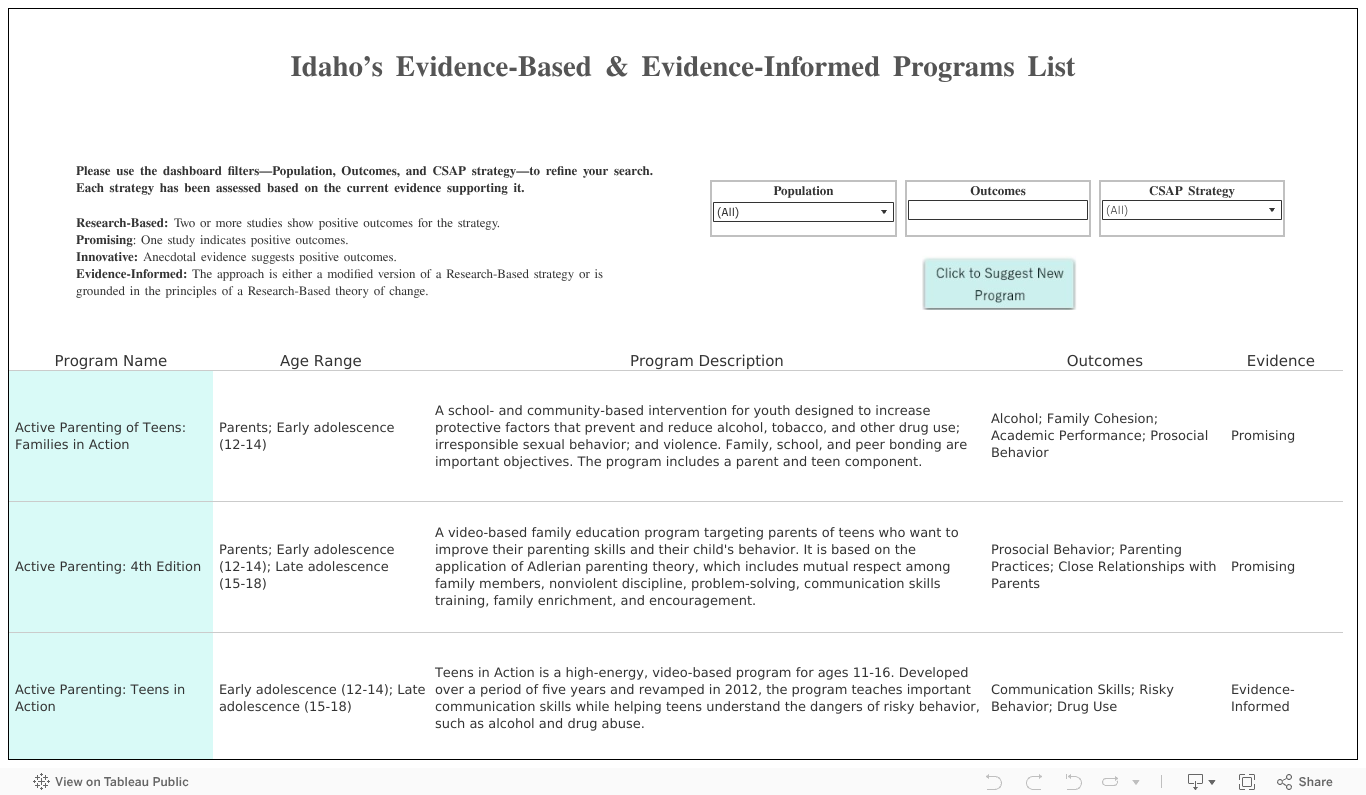
| Active Parenting: Teens in Action | Teens in Action is a high-energy, video-based program for ages 11-16. Developed over a period of five years and revamped in 2012, the program teaches important communication skills while helping teens understand the dangers of risky behavior, such as alcohol and drug abuse. | Youth | Early adolescence (12-14); Late adolescence (15-18) | Communication Skills; Risky Behavior; Drug Use | Prevention Education | Evidence-Informed | Visit site |
| Active Parenting: 4th Edition | A video-based family education program targeting parents of teens who want to improve their parenting skills and their child's behavior. It is based on the application of Adlerian parenting theory, which includes mutual respect among family members, nonviolent discipline, problem-solving, communication skills training, family enrichment, and encouragement. | Parent | Parents; Early adolescence (12-14); Late adolescence (15-18) | Prosocial Behavior; Parenting Practices; Close Relationships with Parents | Prevention Education | Promising | Visit site |
| Brief Alcohol Screening and Intervention for College Students (BASICS) | A brief motivational intervention for high-risk college students that uses alcohol screening and feedback to reduce problem, excessive, and binge drinking by enhancing motivation to change, promoting healthier choices, reviewing myths and facts about alcohol, and teaching coping skills to moderate drinking. | Young Adult | Early adulthood (19-24) | Alcohol | Problem Identification and Referral | Research-Based | Visit site |
| Boomerang Project (Middle School) | A school orientation and transition program that welcomes new middle/high school students and makes them feel comfortable throughout the first year of their middle/high school experience. Built on the belief that students can help students succeed, the program trains mentors from older classes to be leaders. As positive role models, student leaders are mentors who guide the new middle/high school students to discover what it takes to be successful during the transition to middle/high school and help facilitate success. | Youth | Early adolescence (12-14) | Success in School Transitions; Prosocial Behavior; Academic Performance | Alternative | Innovative | Visit site |
| Boomerang Project (High School) | A school orientation and transition program that welcomes new middle/high school students and makes them feel comfortable throughout the first year of their middle/high school experience. Built on the belief that students can help students succeed, the program trains mentors from older classes to be leaders. As positive role models, student leaders are mentors who guide the new middle/high school students to discover what it takes to be successful during the transition to middle/high school and help facilitate success. | Youth | Late adolescence (15-18) | Success in School Transitions; Prosocial Behavior; Academic Performance | Alternative | Innovative | Visit site |
| eCHECKUP TO-GO | Alcohol eCHECKUP TO-GO is a web-based survey that provides students with personalized feedback about their drinking patterns and how their alcohol use might affect their health and personal goals. The program has a special focus on two high-risk groups: first-year students and athletes. eCHEKUP TO GO is a commercial program. Campuses pay an annual subscription fee of about $1,000 for unlimited use of a customized program. | Young Adult | Early adulthood (19-24) | Alcohol; Cannabis; Nicotine; Sexual Violence; Well-being | Problem Identification and Referral | Research-Based | Visit site |
| Active Parenting of Teens: Families in Action | A school- and community-based intervention for youth designed to increase protective factors that prevent and reduce alcohol, tobacco, and other drug use; irresponsible sexual behavior; and violence. Family, school, and peer bonding are important objectives. The program includes a parent and teen component. | Parent | Parents; Early adolescence (12-14) | Alcohol; Family Cohesion; Academic Performance; Prosocial Behavior | Prevention Education | Promising | Visit site |
| Good Behavior Game/PAX Good Behavior Game | A classroom behavior management game providing a strategy to help elementary teachers reduce aggressive, disruptive behavior and other behavioral problems in children, particularly highly aggressive children, while creating a positive and effective learning environment. | Child | Late childhood (5-11) | Antisocial-aggressive Behavior; Internalizing; Mental Health – Other; Suicide/Suicidal Thoughts; Tobacco | Alternative | Promising | Visit site |
| Guiding Good Choices (Communities that Care) | A family competency training program that aims to enhance parenting behaviors and skills, to enhance effective child management behaviors and parent-child interactions and bonding, to teach children skills to resist peer influence, and to reduce adolescent problem behaviors. | Family | Early adolescence (12-14) | Alcohol; Delinquency and Criminal Behavior; Depression; Illicit Drugs | Prevention Education | Research-Based | Visit site |
| Keepin' It Real (KiR) | A substance use prevention and social and emotional competency enhancing program focused on the competencies linked to preventing substance use and misuse. This program is based on the real stories of young adolescents, and program videos provide social modeling of effective strategies. Youth have opportunities to create their media as part of the program. Lessons are designed to teach students how to assess risk, value their perceptions and feelings, and communicate effectively. | Youth | Early adolescence (12-14) | Alcohol; Tobacco; Marijuana/Cannabis; Self-Awareness; Self-Management; Social Awareness; Relationship Skills; Refusal Skills; Responsible Decision-Making | Prevention Education | Research-Based | Visit site |
| LifeSkills Training (Elementary) | A classroom-based substance use prevention program designed to prevent teenage drug and alcohol use, tobacco use, violence, and other risk behaviors by teaching students self-management skills, social skills, and drug awareness and resistance skills. | Child | Late childhood (5-11) | Alcohol; Delinquency and Criminal Behavior; Marijuana/Cannabis; Sexual Risk Behaviors; STIs; Tobacco; Violence | Prevention Education | Innovative | Visit site |
| LifeSkills Training (Middle School) | A classroom-based substance use prevention program designed to prevent teenage drug and alcohol use, tobacco use, violence, and other risk behaviors by teaching students self-management skills, social skills, and drug awareness and resistance skills. | Youth | Early adolescence (12-14) | Alcohol; Delinquency and Criminal Behavior; Marijuana/Cannabis; Sexual Risk Behaviors; STIs; Tobacco; Violence | Prevention Education | Research-Based | Visit site |
| LifeSkills Training (High School) | A classroom-based substance use prevention program designed to prevent teenage drug and alcohol use, tobacco use, violence, and other risk behaviors by teaching students self-management skills, social skills, and drug awareness and resistance skills. | Youth | Late adolescence (15-18) | Alcohol; Delinquency and Criminal Behavior; Marijuana/Cannabis; Sexual Risk Behaviors; STIs; Tobacco; Violence | Prevention Education | Research-Based | Visit site |
| Nurturing Parent Program | A family-centered trauma-informed initiative designed to build nurturing parenting skills as an alternative to abusive and neglecting parenting and child-rearing practices. The long-term goals are to prevent recidivism in families receiving social services, lower the rate of multi-parent teenage pregnancies, reduce the rate of juvenile delinquency and alcohol use, and stop the intergenerational cycle of child abuse by teaching positive parenting behaviors. | Parent | Parents of early adolescence (12-14) | Safety; Child/Family Wellbeing; Parenting Practices; Close Relationships with Parents | Alternative | Innovative | Visit site |
| Positive Action (Elementary) | A school-based social-emotional learning program for students in elementary schools to increase positive behavior, reduce negative behavior, and improve social and emotional learning and school climate. Positive Action is based on the intuitive philosophy that we feel good about ourselves when we do positive actions. The essence of the program is to emphasize those actions that promote a healthy and positive cycle. | Child | Late childhood (5-11) | Academic Performance; Alcohol; Anxiety; Bullying; Close Relationships with Peers; Delinquency and Criminal Behavior; Depression; Emotional Regulation; Illicit Drugs; Marijuana/Cannabis; Positive Social/Prosocial Behavior; Sexual Risk Behaviors; Tobacco; Truancy – School Attendance; Violence | Alternative | Research-Based | Visit site |
| Positive Action (Middle School) | A school-based social-emotional learning program for students in elementary schools to increase positive behavior, reduce negative behavior, and improve social and emotional learning and school climate. Positive Action is based on the intuitive philosophy that we feel good about ourselves when we do positive actions. The essence of the program is to emphasize those actions that promote a healthy and positive cycle. | Youth | Early adolescence (12-14) | Academic Performance; Alcohol; Anxiety; Bullying; Close Relationships with Peers; Delinquency and Criminal Behavior; Depression; Emotional Regulation; Illicit Drugs; Marijuana/Cannabis; Positive Social/Prosocial Behavior; Sexual Risk Behaviors; Tobacco; Truancy – School Attendance; Violence | Prevention Education | Research-Based | Visit site |
| Project ALERT | A classroom-based substance use prevention program designed to reduce the experimental and continued use of drugs. Through comprehensive lessons, Project ALERT aims to motivate students against drug use, cultivate new nonuse attitudes and beliefs, and equip teens with the skills and strategies they will use to resist drugs. | Youth | Early adolescence (12-14) | Alcohol; Tobacco; Marijuana/Cannabis; Refusal skills; Responsible Decision-Making | Alternative | Innovative | Visit site |
| Project Towards No Drug Abuse (PTNDA) | A classroom-based drug prevention program designed for at-risk youth that aims to prevent teen drinking, smoking, marijuana, and other hard drug use. Project Towards No Drug Abuse (PTND) focuses on three factors that predict substance use and other problem behaviors among youth, including motivation factors, skills, and decision-making. | Youth | Late adolescence (15-18) | Alcohol; Illicit Drugs Marijuana/Cannabis; Tobacco; Violence | Prevention Education | Research-Based | Visit site |
| Project Towards No Tobacco Use (PTNT) | Project Towards No Tobacco Use (PTND) is designed to counteract multiple causes of tobacco use simultaneously. PTNT is based on the theory that youth will be better able to resist tobacco use if they are aware of misleading information that facilitates tobacco use, have skills that counteract the social pressures to obtain approval by using tobacco, and appreciate the physical consequences of tobacco use. | Youth | Early adolescence (12-14) | Tobacco | Prevention Education | Research-Based | Visit site |
| Refuse, Remove, Reasons (RRR) (High School) | A substance use prevention program that is designed to reduce high school students’ favorable attitudes toward the use of alcohol, tobacco, and other drugs, decrease their misperception of normative peer use, and increased their refusal skills. | Youth | Late adolescence (15-18) | Perceived Risk of Drug Use; Refusal Skills; Alcohol; Tobacco; Marijuana; Opioids | Prevention Education | Research-Based | Visit site |
| Second Step (Elementary School) | A universal, classroom-based program designed to increase children's school readiness and decrease problem behaviors by promoting social-emotional competence and self-regulation. It offers direct instruction and teaches skills that strengthen students' ability to learn, have empathy, manage emotions, and solve problems. | Child | Late childhood (5-11) | Social/Prosocial Skills; Student Conduct and Engagement; Academic Performance | Prevention Education | Innovative | Visit site |
| Second Step (Middle School) | A universal, classroom-based program designed to increase children's school readiness and decrease problem behaviors by promoting social-emotional competence and self-regulation. It offers direct instruction and teaches skills that strengthen students' ability to learn, have empathy, manage emotions, and solve problems. | Child | Late childhood (5-11) | Social/Prosocial Skills; Student Conduct and Engagement; Academic Performance | Prevention Education | Innovative | Visit site |
| Strengthening Families | A group parenting and youth skills program aimed to promote good parenting skills and positive family relationships; reduce aggressive, hostile behavior; reduce substance use in adolescence; and improve family relationships through weekly parent effectiveness training and child skills-building, followed by a family session. | Family | Parents of late childhood (5-11) | Alcohol; Antisocial-aggressive Behavior; Close Relationships with Parents; Internalizing; Tobacco | Prevention Education | Promising | Visit site |
| Too Good for Drugs (Elementary) | A developmentally appropriate prevention program that builds resiliency by teaching social competence and problem-solving skills. It aims to increase social and emotional competencies, mitigate the risk factors, and build protective factors related to substance use and other problem behaviors. Substance use topics are discussed in the context of expectations, peer pressure and influence, and the media. Complex social challenges and influences that present a greater risk for escapism and risky behavior are explored and met with strategies for managing them in a positive, healthy way. Interactive games and activities create an experiential learning environment so students can learn and apply the skills in the classroom setting. | Child | Late childhood (5-11) | Setting Goals; Decision-Making Skills; Prosocial Behavior; Anger Management; Communication Skills | Prevention Education | Innovative | Visit site |
| Too Good for Drugs (Middle School) | A developmentally appropriate prevention program that builds resiliency by teaching social competence and problem-solving skills. It aims to increase social and emotional competencies, mitigate the risk factors, and build protective factors related to substance use and other problem behaviors. Substance use topics are discussed in the context of expectations, peer pressure and influence, and the media. Complex social challenges and influences that present a greater risk for escapism and risky behavior are explored and met with strategies for managing them in a positive, healthy way. Interactive games and activities create an experiential learning environment so students can learn and apply the skills in the classroom setting. | Youth | Early adolescence (12-14) | Setting Goals; Decision-Making Skills; Prosocial Behavior; Anger Management; Communication Skills | Prevention Education | Innovative | Visit site |
| Too Good for Drugs (High School) | A developmentally appropriate prevention program that builds resiliency by teaching social competence and problem-solving skills. It aims to increase social and emotional competencies, mitigate the risk factors, and build protective factors related to substance use and other problem behaviors. Substance use topics are discussed in the context of expectations, peer pressure and influence, and the media. Complex social challenges and influences that present a greater risk for escapism and risky behavior are explored and met with strategies for managing them in a positive, healthy way. Interactive games and activities create an experiential learning environment so students can learn and apply the skills in the classroom setting. | Youth | Late adolescence (15-18) | Setting Goals; Decision-Making Skills; Prosocial Behavior; Anger Management; Communication Skills | Prevention Education | Innovative | Visit site |
| Fostering Healthy Futures (Preteens) | Fostering Healthy Futures® for Preteens (FHF-P) is a positive youth development program for preadolescent children (ages 9-11) who have current or previous child welfare involvement due to one or more adverse childhood experiences (ACEs). These ACEs may include maltreatment, out-of-home placement, instability in housing, caregivers or schools, and/or parental substance use, mental illness, or incarceration. | Child | Late childhood (5-11) | Improved mental health; Fewer trauma symptoms; Reduction in long-term suicidality; Reduced justice involvement; Fewer short-term risk factors for substance use; Reduced substance use | Alternative | Research-Based | Visit site |
| Fostering Healthy Futures (Teens) | Fostering Healthy Futures® for Teens (FHF-T) is a 30-week mentoring program for 8th and 9th graders with current or previous child welfare involvement due to one or more adverse childhood experiences (ACEs). These ACEs may include maltreatment, out-of-home placement, instability in housing, caregivers or schools, and/or parental substance use, mental illness, or incarceration. FHF-T builds on youth’s strengths and interests by engaging teens in visioning and goal-setting exercises, skills training, and workshops to build on their competencies and reduce adverse outcomes. | Youth | Early adolescence (12-14) | Reduces juvenile justice involvement and increases permanency. | Alternative | Evidence-Informed | Visit site |
| Winning Futures- Workforce Prep | Workforce Prep is our structured and evidence-based seven-year program. Students are immersed in an experiential curriculum that includes in-class career mentoring, life skills development, goal setting, job readiness training, and career exploration. Students enter the program in tenth grade and receive training, guidance, and support through four years of post-high school continuing education. | Youth | Early adolescence (12-14) | Career mentoring; Life skills development; Goal setting; Job readiness training; Career exploration | Alternative | Evidence-Informed | Visit site |
| Project AMP | Project Amp is an extended brief mentorship intervention that utilizes the power of young adult peer mentors to implement a youth-focused, strengths-based, and non-punitive prevention and early intervention resource. This multi-session intervention originated within a Screening, Brief Intervention, and Referral to Treatment (SBIRT) framework, and pairs youth with young adults with lived experience of recovery and resiliency specific to substance use, mental health, trauma or related challenges. Mentors meet with youth over four to six sessions and together, they work toward exploring youth participant’s strengths and interests, navigating pressures and well-being, understanding alcohol and drug risks, developing self-efficacy, clarifying values, achieving goals, and finding positive social connections in the school and community. | Youth | Early adolescence (12-14); Late adolescence (15-18) | Strengths and interests; Navigating pressures and well-being; Understanding alcohol and drug risks; Developing self-efficacy; Clarifying values; Achieving goals; Positive social connections | Alternative | Evidence-Informed | Visit site |
| Raising Healthy Children (Communities that Care) | Raising Healthy Children (RHC) is a comprehensive, school-based preventive intervention that promotes positive youth development. The program covers children from kindergarten through high school with developmentally and age-appropriate material at different stages with primary goals of increasing school commitment, academic performance, and social competency, and reducing antisocial behavior. The program includes teacher workshops, parent training, and student interventions to address identified needs. | Community | Community | School commitment; Academic performance; Social competency; Reduce antisocial behavior. | Prevention Education | Evidence-Informed | Visit site |
| Families Facing the Future (Communities that Care) | The Families Facing the Future program was developed to address the needs of families when parents are addicted to drugs or alcohol. Families Facing the Future parent sessions consist of one five-hour family retreat and 32 hour-and-a-half parent training workshops conducted twice a week over a 16-week period. Children attend 12 of these sessions to practice skills with their parents. | Family | Parents; Late childhood (5-11) | Life skills development | Prevention Education | Evidence-Informed | Visit site |
| Connecting (Communities that Care) | The Connecting program is a self-directed, family-focused, substance abuse and risky sexual behavior prevention program for foster teens and their caregivers. Connecting is an adaptation for use in the child welfare system of Staying Connected with Your Teen (SCT), a family-based, self-directed prevention program that has shown long-term (2-year) effects in reducing initiation into drug use and sexual activity, and has reduced the frequency of violent behaviors, especially among low-income African American teens. In 2019 an additional module focusing on sexual orientation and gender identity and expression was added. | Family | Parents; Early adolescence (12-14); Late adolescence (15-18) | Reduce initiation into drug use; Reduce sexual activity; Reduce violent behaviors | Prevention Education | Evidence-Informed | Visit site |
| Staying Connected with Your Teen (Communities that Care) | Staying Connected with Your Teen (SCT) is s a seven-session universal prevention program that addresses substance abuse and problem behavior in middle-schoolers. SCT consists of either five 2-hour sessions (when used in a workshop setting) or seven discussion units (when used as a self-paced home-study program). The program has video and workbook components. | Youth | Early adolescence (12-14) | Substance misuse; Problem behavior | Prevention Education | Evidence-Informed | Visit site |
| Smart Talk: Cannabis Prevention & Awareness Curriculum | Smart Talk: Cannabis Prevention & Awareness Curriculum is a 5-lesson theory-based and evidence-informed curriculum created by the Stanford REACH Lab as well as by our Youth Action Board, educators, healthcare providers, and scientists across the U.S. | Youth | Early adolescence (12-14); Late adolescence (15-18) | Cannabis Prevention | Prevention Education | Evidence-Informed | Visit site |
| Healthy Futures Alternative-to-Suspension Program | Alternative to Suspension Curriculums geared for students who have been caught using cannabis (or really any cannabis or tobacco product) and/or for any students who are interested in trying to quit. | Youth | Early adolescence (12-14); Late adolescence (15-18) | Cannabis Prevention | Problem Identification and Referral | Evidence-Informed | Visit site |
| You and Me, Together Vape-Free | The You and Me, Together Vape-Free curriculum includes a middle and high school program that are 6 lessons, approximately 50 minutes each. It also includes a two-lesson elementary school version, approximately 50 minutes each. Every lesson provides activities, online quiz games, and worksheets in addition to presentations, resources, and other materials aimed at addressing key factors associated with youth e-cigarette use. | Youth | Early adolescence (12-14); Late adolescence (15-18) | Tobacco Prevention | Prevention Education | Evidence-Informed | Visit site |
| Healthy Futures Alternative-to-Suspension Program: Nicotine Version | This program is geared for students who have been caught using e-cigarettes (or really any tobacco product) and/or for any students who are interested in trying to quit. This program is packed with a self-paced lesson, a group 2- or 4-hour teacher or counselor-led curriculum, quitting resources, and more! | Youth | Early adolescence (12-14); Late adolescence (15-18) | Tobacco Prevention | Problem Identification and Referral | Evidence-Informed | Visit site |
| Drug Prevention and Intervention Toolkit (Stanford REACH Lab) | Toolkits are developed by the Stanford REACH Lab and comprise of a collection of curriculums, lessons, programs, and resources catered to a specific topic. | Youth | Early adolescence (12-14); Late adolescence (15-18) | Drug Prevention | Prevention Education | Evidence-Informed | Visit site |
| The Communities Mobilizing for Change on Alcohol (CMCA) | CMCA works because it combines multiple, evidence-based alcohol prevention strategies to create changes at the community level. Changing things in the environment that put teens at risk for drinking is what we call an environmental prevention strategy. Every day, teens are exposed to messages from media and from their communities that influence their opinions about alcohol. Seeing a liquor store on the way to school, weakly enforced underage drinking laws, invitations to parties with alcohol, and other environmental cues make alcohol use more appealing. Environmental prevention goes beyond scaring teens into avoiding alcohol (which doesn’t work well) by changing the environment that makes drinking alcohol easy | Youth | Early adolescence (12-14); Late adolescence (15-18) | Alcohol Prevention | Environmental Strategy | Evidence-Informed | Visit site |